
AZHIAN SAZEH MAHABAzhian Sazeh Mahab
A project-led website that communicates a construction company’s delivery capability through evidence, services, and a real track record.
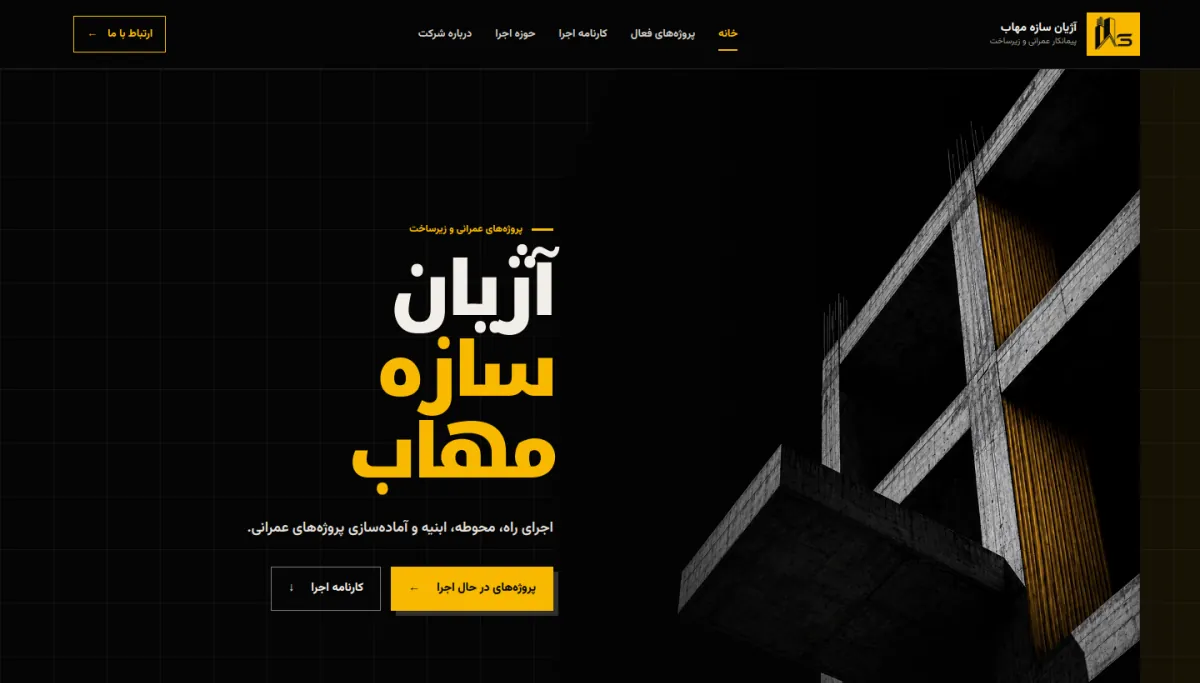
Image from the project’s public version, captured to document this case study.
How does the project work?
The four stages below show the product’s primary flow without exposing sensitive data or details.
- 01 / 04
Presenting capability
The audience learns about the company’s field of work and delivery approach.
- 02 / 04
Viewing projects
Delivery evidence and project status create a more tangible picture.
- 03 / 04
Reviewing the record
The company record and development path provide context for assessing a collaboration.
- 04 / 04
Starting a conversation
A clear contact path takes the audience to discussion of the next project.
In construction, an image without evidence is not enough
Corporate sites in this field often get caught between two poles: generic formal copy or galleries that do not explain a project’s context and scale. For Azhian Sazeh, the project needed to be the principal unit of the story.
The goal was for visitors to reach a more coherent understanding of the company’s capability through its services, track record, and active projects.
A professional identity built on responsible delivery
The brand position was not built with large, unmeasurable claims. Its core message focused on precision in construction and responsibility in delivery—two concepts that are understandable and relevant when assessing a contractor.
The dark, structural visual language draws on architectural lines to convey engineering and control rather than imitate construction catalogues.
Projects became the backbone of content
The site structure moves from the company introduction to services, current projects, delivery record, and development path. Each section must answer a different question and move visitors to the next evaluation stage.
This architecture lets new projects be added later without changing the site’s overall language and gradually turns the company record into a usable archive.
An industrial rhythm without extra decoration
Project images sit in a regular, high-contrast grid. Large typography and negative space keep attention on project names and delivery evidence.
Interface details use lines, numbers, and status labels so the page language aligns with project logic and technical reporting.
A structure that grows with the track record
A project-led site must be extensible for the company team. Content categories and the project-presentation pattern were designed so new experience does not require redesigning the homepage.
Contractual information, figures, and technical project details appear only at a level approved for public release.
A corporate presentation grounded in what has been built
The live version now places the company’s services, active projects, track record, and development path together in one narrative.
In a future update, case studies of delivery work within the company site can become deeper as additional images and data arrive for each project.
What was built within the project scope.
This list is based on project outputs that can be stated publicly—not speculative features or unverified technology.
- 01Corporate introduction strategy
- 02Web visual identity and language
- 03Service architecture
- 04Delivery-project pattern
- 05Track record and development path
- 06Commercial contact path
- CORPORATE WEB
- CONTENT STRATEGY
- VISUAL SYSTEM
- PROJECT ARCHIVE
Do you have a similar challenge?
If your project sits between web, operations, content, and automation, we can first clarify the problem and the shortest path to build it.
Start a conversation on Telegram