
EMDAD ISAREmdad Isar
Turning a private ambulance provider’s website into part of its acquisition, content, call-analysis, and infrastructure-maintenance engine.
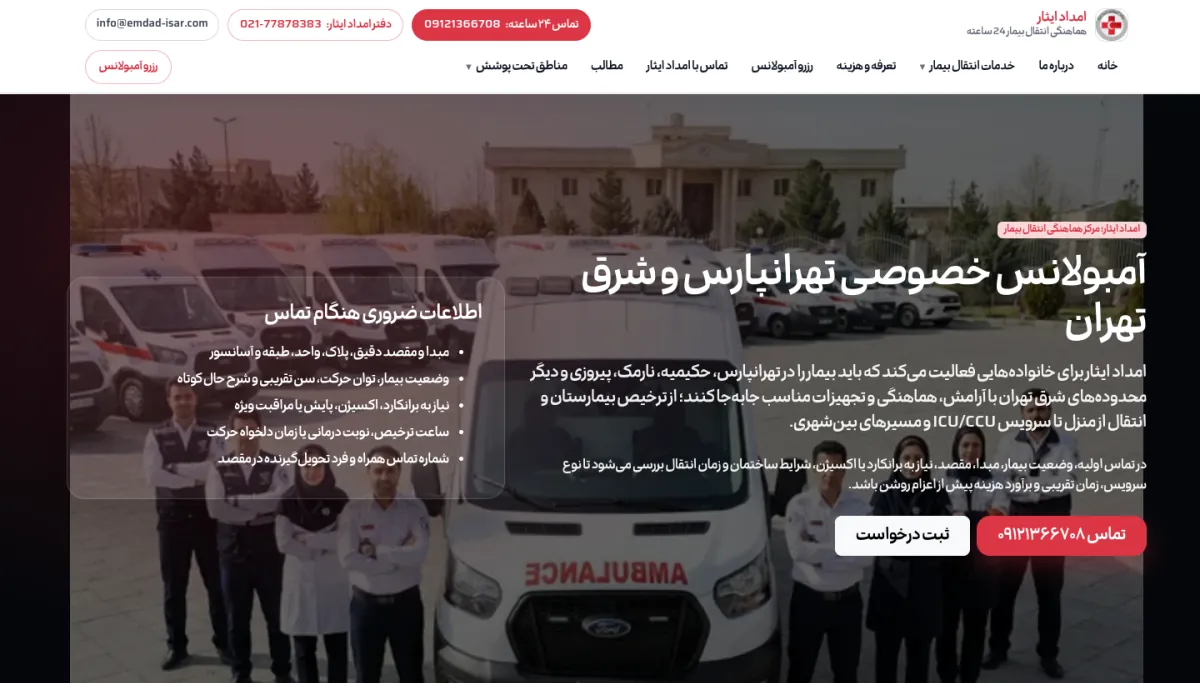
Image from the project’s public version, captured to document this case study.
How does the project work?
The four stages below show the product’s primary flow without exposing sensitive data or details.
- 01 / 04
Urgent need
The user arrives from search or a direct entry point with a specific problem.
- 02 / 04
Local answer
A focused page clarifies the service area and information needed before calling.
- 03 / 04
Call and coordination
The user reaches a direct call path and the team receives the necessary data.
- 04 / 04
Analysis and improvement
Call patterns and entry content are reviewed to improve pages and operations.
A website for a time-sensitive service
Ambulance-service users do not usually visit a site for lengthy browsing. They need to quickly understand whether the provider suits their situation, area, and transport type, and what information to have ready when calling.
The website was therefore not designed as a public brochure; it is part of service coordination and must create minimal friction from search through the call.
Every search has an operational question
The local SEO structure was built on real service coverage and user intent. Pages must clarify the differences between areas, transport types, and coordination conditions—not reproduce one repeated text with different neighborhood names.
In the live version, core services, coordination stages, cost factors, and an accompanying-person checklist sit directly in the reading path.
Content as infrastructure, not a short campaign
Content production has operational value when its research, writing, evaluation, and publication are a repeatable flow. Part of the project was devoted to building that cycle and automating stages that can be automated.
Automation does not replace human decisions about medical accuracy, service coverage, or commercial claims; it reduces repetitive work and enables more regular review.
A call is not the last click; it is product data
In a business where the primary conversion happens by phone, knowing visit counts alone is not enough. Call analysis helps show which entries reached a real conversation and what uncertainties users had before calling.
This perspective joins website and operations: the next content and path improvements should be informed by call reality, not only assumptions about keywords.
Reliability is part of the user experience
For a time-sensitive service, a slow or unavailable site is not merely a technical defect. Infrastructure maintenance, service monitoring, and control of content releases were treated as part of the project scope.
Security details and operational architecture are not public, but the decision principle is clear: a growth layer cannot last without reliable infrastructure.
A continuous loop between search, calls, and improvement
The final output is not a single website; it is a system that publishes local content, prepares users to call, and uses real signals for subsequent improvement.
Detailed call statistics and commercial performance are confidential and will be added to the public case study only with client approval.
What was built within the project scope.
This list is based on project outputs that can be stated publicly—not speculative features or unverified technology.
- 01Website redesign and development
- 02Service and local-page architecture
- 03Content-cycle automation
- 04Call analytics
- 05Infrastructure maintenance
- 06Continuous monitoring and improvement
- WEB DEVELOPMENT
- LOCAL SEO
- CONTENT AUTOMATION
- CALL ANALYTICS
- INFRASTRUCTURE
Do you have a similar challenge?
If your project sits between web, operations, content, and automation, we can first clarify the problem and the shortest path to build it.
Start a conversation on Telegram