
DAKOTEBDakoteb
A fast static website for in-home medical services, with focused pages and an independent content foundation.
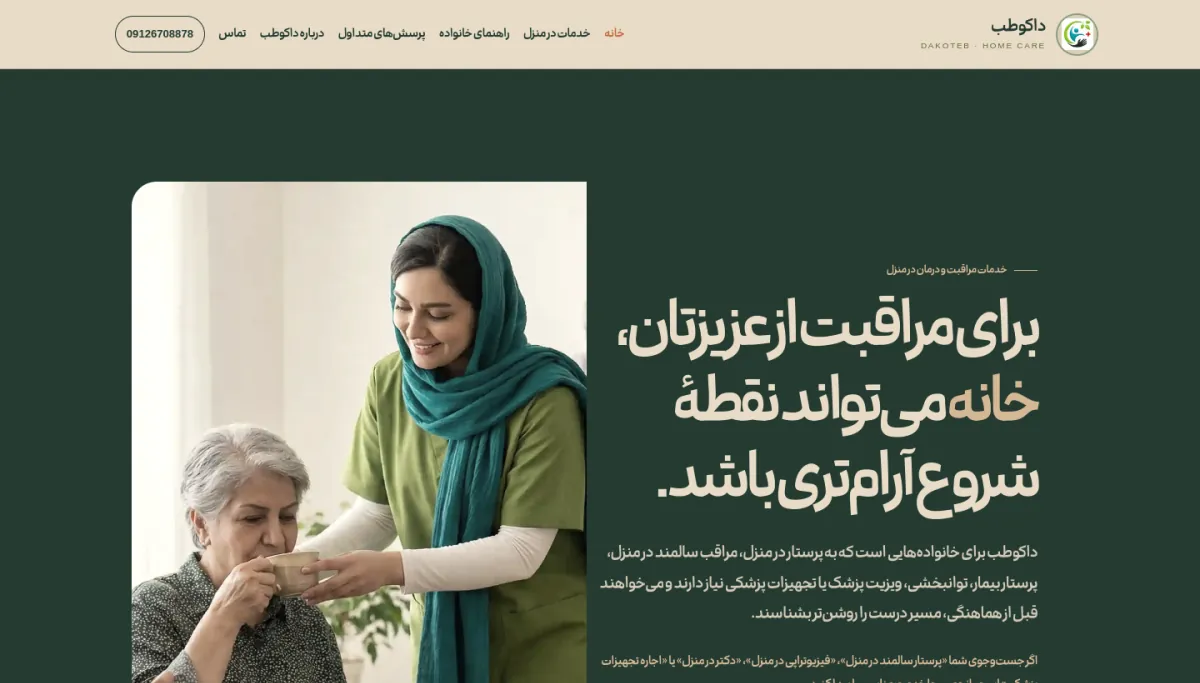
Image from the project’s public version, captured to document this case study.
How does the project work?
The four stages below show the product’s primary flow without exposing sensitive data or details.
- 01 / 04
Choosing a need
Users find the service need closest to their situation.
- 02 / 04
Focused page
Each service is presented independently with an explanation, conditions, and coordination path.
- 03 / 04
Decision readiness
Questions and guides reduce uncertainty before the call.
- 04 / 04
Direct contact
Users act without passing through unnecessary forms or steps.
Many services without becoming a crowded list
In-home services cover needs from elder care to rehabilitation and post-discharge nursing. If all these needs are combined on one page, users cannot tell which path relates to their situation.
Dakoteb was designed around selecting a need and entering the page for that specific service.
Simple architecture as a product decision
A content site does not necessarily need a runtime or a heavy panel to provide fast, stable pages. Static output was chosen to keep response time, maintenance overhead, and execution dependencies low.
This choice keeps development attention on page quality and the user path rather than managing complex infrastructure.
Every service is an independent, extensible document
Pages were shaped around a specific user intent, and each should be readable and updatable independently. The homepage acts as a guide, not a place to accumulate every detail.
Guides and frequently asked questions are not separate from the sales page; they help families prepare to choose and call.
A calm tone for a family decision
A decision about care for a patient or older adult is often made under time and emotional pressure. The interface should organize information and make the action path clear without creating fear or artificial urgency.
Human imagery, negative space, and direct headings help maintain that balance.
Speed is part of usability
Reducing dependencies, using a lightweight structure, and delivering pages directly matters more to mobile users—especially when they arrive from search under urgent conditions.
Performance-test figures are not published in this version and will be added after a reproducible measurement is run.
An independent base for service-content growth
The live version now presents frequently searched services, guides, and the contact path in an extensible architecture.
Ranking and call results have not been confirmed for public release; instead of numerical claims, this case study focuses on the architecture and visible output.
What was built within the project scope.
This list is based on project outputs that can be stated publicly—not speculative features or unverified technology.
- 01Static architecture
- 02Service-page model
- 03Guiding homepage
- 04Guides and FAQ
- 05Contact path
- 06Independent content foundation
- STATIC WEB
- PERFORMANCE
- CONTENT MODEL
- MEDICAL UX
Do you have a similar challenge?
If your project sits between web, operations, content, and automation, we can first clarify the problem and the shortest path to build it.
Start a conversation on Telegram